Underground bunker and shelter permit rules by state
There's no federal permit for a home bunker or underground shelter. A buried shelter is treated like most other construction on your lot. The building code your state or local government has adopted decides whether you need a building permit and what the plans must show, and zoning decides where on the lot the shelter can go. Floodplain rules, HOA covenants and the call to 811 before digging sit on top of that.
So the real answer comes from the building department that covers your address. This guide explains what the model codes say, shows which states have adopted a residential code statewide, and lists questions to ask before you buy a shelter.
What the model building code says
Most states and many cities base their rules on the International Residential Code (IRC) for houses and the International Building Code (IBC) for other buildings. Section R105.1 of the 2021 IRC requires a permit to build a structure, and to install or change electrical, gas, mechanical or plumbing systems (2021 IRC sections R105.1 and R105.2 (copy posted by Grant County, Washington)).
Section R105.2 lists work that doesn't need a building permit. The first item is a one-story detached accessory structure of 200 square feet or less, and the exemption opens with the words "other than storm shelters." Under the model code, then, a small storm shelter needs a permit even though a garden shed of the same size might not. The same section says an exemption never allows work that breaks the code or other local laws (2021 IRC sections R105.1 and R105.2 (copy posted by Grant County, Washington)).
A bunker that nobody calls a storm shelter is still a structure, so the general permit rule applies to it. When a shelter is meant to protect people from tornadoes or hurricanes, the code points its design to the ICC 500 standard (FEMA, Highlights of ICC 500-2023). No code standard covers fallout, blast or EMP protection for a home. The fallout and EMP guide explains what that means when you talk to builders.
Zoning, setbacks and other local rules
Zoning is separate from the building code, and the city or county planning office usually runs it. For an accessory structure, zoning can set:
- how far it must sit from property lines and other buildings
- how much of the lot can be covered
- whether anything can go in a utility or drainage easement
- where hatches, vent pipes and other parts above ground can go
Depending on the site, other rules can come in:
- Floodplain. FEMA says safe rooms aren't allowed in floodways and shouldn't be used where flooding is expected (FEMA, flood siting criteria for residential safe rooms). If your lot is in a mapped flood zone, ask the local floodplain manager before anything else.
- Buried utilities. 811 is the national call-before-you-dig number. Call or file online a few business days before digging, and wait until every utility has marked its lines (Call 811, Before You Dig).
- Wiring, plumbing and fuel. R105.1 covers electrical, gas, mechanical and plumbing work, so a shelter with power, a toilet or a generator can need more than one permit (2021 IRC sections R105.1 and R105.2 (copy posted by Grant County, Washington)).
- HOA covenants. A homeowners association can limit structures or digging even where the city allows them, so read the covenants before you sign with a builder.
Shipping containers need engineering
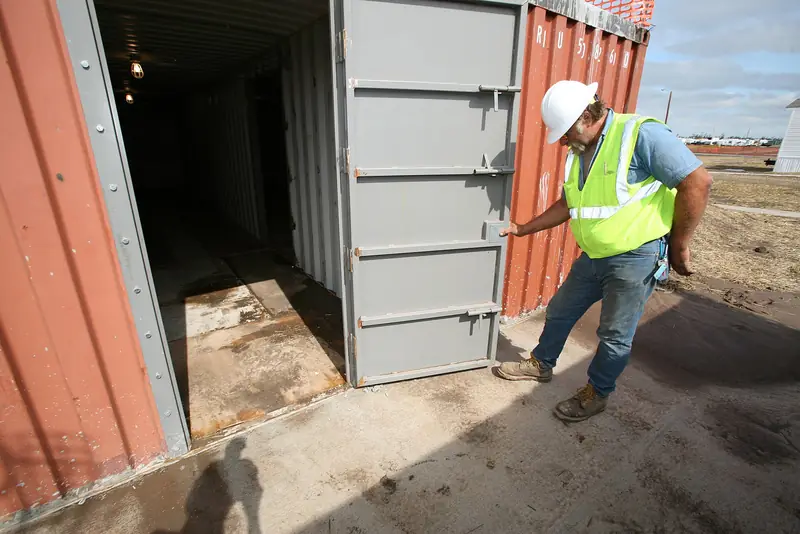
A buried shipping container usually gets more scrutiny, not less. San Joaquin County, California, says converted cargo containers aren't conventional construction. Any container used for something other than its approved use needs plans and structural calculations stamped by a California-licensed architect or engineer (San Joaquin County, California, cargo container permit requirements). Conexwest, which sells containers, says a standard one shouldn't be fully buried without professional engineering and major reinforcement (Conexwest, burying a shipping container). The bunker cost guide explains why.
What a local shelter permit looks like
Cities in tornado country often have a simple permit just for shelters. A few published examples:
- Oklahoma City requires a building permit for above-ground and below-ground storm shelters. The fee is $99.50 for an in-ground or slope-top shelter and $104.50 for an above-ground safe room. After inspection, owners can register the shelter with the city (City of Oklahoma City, Storm Shelter Permit).
- Jonesboro, Arkansas, reviews building plans and lists a storm shelter permit in its fee schedule. Owners can add a finished shelter to the E-911 Storm Shelter Registry so responders know where to look (City of Jonesboro, Plan Review; City of Jonesboro, Inspections and Planning fee schedule; Jonesboro E-911 Storm Shelter Registry).
- Wisconsin doesn't use the IRC for houses. One- and two-family homes fall under the state's own Uniform Dwelling Code (Wisconsin DSPS, Uniform Dwelling Code).
Residential code adoption by state
The International Code Council's April 2026 chart tracks which edition of its codes each state has adopted (ICC, International Codes adoption by state, April 2026 (copy posted by MiTek)). By that chart, 39 states and DC have a statewide IRC edition and 10 leave the residential code to local or state agencies. A year means the state adopted that edition. "Local only" means one or more state or local agencies use the code, but it isn't the standard for all buildings statewide. ICC notes that not every jurisdiction reports its adoptions and that a state adoption affects local rules differently from place to place. Treat the list as a starting point and confirm with your local office.
| State | Residential code (IRC) | Building code (IBC) | What it means for a home shelter |
|---|---|---|---|
| Alabama | 2015 | 2021 | The state has adopted the 2015 IRC. Cities and counties enforce it, and some add local amendments. |
| Alaska | Local only | 2021 | No statewide residential code. Some state or local agencies use the IRC, so your city or county sets the rules. |
| Arizona | Local only | Local only | No statewide residential code. Some state or local agencies use the IRC, so your city or county sets the rules. |
| Arkansas | 2021 | 2021 | The state has adopted the 2021 IRC. Cities and counties enforce it, and some add local amendments. |
| California | 2024 | 2024 | The state has adopted the 2024 IRC. Cities and counties enforce it, and some add local amendments. |
| Colorado | Local only | Local only | No statewide residential code. Some state or local agencies use the IRC, so your city or county sets the rules. |
| Connecticut | 2021 | 2021 | The state has adopted the 2021 IRC. Cities and counties enforce it, and some add local amendments. |
| Delaware | Local only | Local only | No statewide residential code. Some state or local agencies use the IRC, so your city or county sets the rules. |
| District of Columbia | 2015 | 2015 | The state has adopted the 2015 IRC. Cities and counties enforce it, and some add local amendments. |
| Florida | 2021 | 2021 | The state has adopted the 2021 IRC. Cities and counties enforce it, and some add local amendments. |
| Georgia | 2024 | 2024 | The state has adopted the 2024 IRC. Cities and counties enforce it, and some add local amendments. |
| Hawaii | 2018 | 2018 | The state has adopted the 2018 IRC. Cities and counties enforce it, and some add local amendments. |
| Idaho | 2018 | 2018 | The state has adopted the 2018 IRC. Cities and counties enforce it, and some add local amendments. |
| Illinois | Local only | Local only | No statewide residential code. Some state or local agencies use the IRC, so your city or county sets the rules. |
| Indiana | 2018 | 2012 | The state has adopted the 2018 IRC. Cities and counties enforce it, and some add local amendments. |
| Iowa | 2024 | 2024 | The state has adopted the 2024 IRC. Cities and counties enforce it, and some add local amendments. |
| Kansas | Local only | Local only | No statewide residential code. Some state or local agencies use the IRC, so your city or county sets the rules. |
| Kentucky | 2015 | 2015 | The state has adopted the 2015 IRC. Cities and counties enforce it, and some add local amendments. |
| Louisiana | 2021 | 2021 | The state has adopted the 2021 IRC. Cities and counties enforce it, and some add local amendments. |
| Maine | 2021 | 2021 | The state has adopted the 2021 IRC. Cities and counties enforce it, and some add local amendments. |
| Maryland | 2021 | 2021 | The state has adopted the 2021 IRC. Cities and counties enforce it, and some add local amendments. |
| Massachusetts | 2021 | 2021 | The state has adopted the 2021 IRC. Cities and counties enforce it, and some add local amendments. |
| Michigan | 2015 | 2021 | The state has adopted the 2015 IRC. Cities and counties enforce it, and some add local amendments. |
| Minnesota | 2018 | 2018 | The state has adopted the 2018 IRC. Cities and counties enforce it, and some add local amendments. |
| Mississippi | 2024 | 2024 | The state has adopted the 2024 IRC. Cities and counties enforce it, and some add local amendments. |
| Missouri | Local only | Local only | No statewide residential code. Some state or local agencies use the IRC, so your city or county sets the rules. |
| Montana | 2021 | 2021 | The state has adopted the 2021 IRC. Cities and counties enforce it, and some add local amendments. |
| Nebraska | 2018 | 2018 | The state has adopted the 2018 IRC. Cities and counties enforce it, and some add local amendments. |
| Nevada | Local only | Local only | No statewide residential code. Some state or local agencies use the IRC, so your city or county sets the rules. |
| New Hampshire | 2021 | 2021 | The state has adopted the 2021 IRC. Cities and counties enforce it, and some add local amendments. |
| New Jersey | 2021 | 2021 | The state has adopted the 2021 IRC. Cities and counties enforce it, and some add local amendments. |
| New Mexico | 2021 | 2021 | The state has adopted the 2021 IRC. Cities and counties enforce it, and some add local amendments. |
| New York | 2024 | 2024 | The state has adopted the 2024 IRC. Cities and counties enforce it, and some add local amendments. |
| North Carolina | 2021 | 2021 | The state has adopted the 2021 IRC. Cities and counties enforce it, and some add local amendments. |
| North Dakota | 2024 | 2024 | The state has adopted the 2024 IRC. Cities and counties enforce it, and some add local amendments. |
| Ohio | 2018 | 2021 | The state has adopted the 2018 IRC. Cities and counties enforce it, and some add local amendments. |
| Oklahoma | 2018 | 2018 | The state has adopted the 2018 IRC. Cities and counties enforce it, and some add local amendments. |
| Oregon | 2021 | 2024 | The state has adopted the 2021 IRC. Cities and counties enforce it, and some add local amendments. |
| Pennsylvania | 2021 | 2021 | The state has adopted the 2021 IRC. Cities and counties enforce it, and some add local amendments. |
| Rhode Island | 2018 | 2021 | The state has adopted the 2018 IRC. Cities and counties enforce it, and some add local amendments. |
| South Carolina | 2021 | 2021 | The state has adopted the 2021 IRC. Cities and counties enforce it, and some add local amendments. |
| South Dakota | 2021 | 2021 | The state has adopted the 2021 IRC. Cities and counties enforce it, and some add local amendments. |
| Tennessee | 2018 | 2021 | The state has adopted the 2018 IRC. Cities and counties enforce it, and some add local amendments. |
| Texas | 2012 | 2012 | The state has adopted the 2012 IRC. Cities and counties enforce it, and some add local amendments. |
| Utah | 2021 | 2021 | The state has adopted the 2021 IRC. Cities and counties enforce it, and some add local amendments. |
| Vermont | Local only | 2021 | No statewide residential code. Some state or local agencies use the IRC, so your city or county sets the rules. |
| Virginia | 2021 | 2021 | The state has adopted the 2021 IRC. Cities and counties enforce it, and some add local amendments. |
| Washington | 2021 | 2021 | The state has adopted the 2021 IRC. Cities and counties enforce it, and some add local amendments. |
| West Virginia | 2018 | 2018 | The state has adopted the 2018 IRC. Cities and counties enforce it, and some add local amendments. |
| Wisconsin | Not adopted | 2021 | Uses its own Uniform Dwelling Code for one- and two-family homes, run by the state Department of Safety and Professional Services. |
| Wyoming | Local only | 2024 | No statewide residential code. Some state or local agencies use the IRC, so your city or county sets the rules. |
Questions to ask the building department
- Is my address under the city or the county? Land outside city limits often follows county rules.
- Which code edition do you enforce, and have you changed the storm shelter or accessory structure sections?
- Do I need a building permit for a buried shelter, and do the plans need an engineer's stamp?
- What setbacks apply, and can any part of the shelter or its vents sit in an easement?
- Do electrical, plumbing, generator or fuel tank work need separate permits?
- Is the lot in a mapped floodplain?
- Do you keep a shelter registry for first responders?
Ask the builder too. A shelter seller should be able to supply engineering drawings for the permit file and tell you whether the permit is in their price. HomeGuide puts building permits for large projects at $500 to $2,000 (HomeGuide bunker cost guide). Simple shelter permits like Oklahoma City's cost much less.
Common questions
Do I need a permit to build an underground bunker?
In most places, yes. The model residential code requires a permit to build a structure, and its exemption for small sheds specifically leaves out storm shelters. The building department for your address has the final word, so ask before you buy or dig.
Is there a federal permit or law for home bunkers?
No federal permit covers a private bunker or underground shelter. The rules come from the building code and zoning that your state, county or city has adopted, plus floodplain rules and any HOA covenants.
What if my state has no statewide building code?
Then the city or county usually decides. In states such as Missouri, Colorado and Arizona, the ICC chart shows the residential code adopted locally rather than statewide, so the rules can differ from one county to the next. Call the office that covers your address.
Can I bury a shipping container as a bunker?
Not safely without engineering. A container's roof and walls aren't built to hold back soil and groundwater, and container seller Conexwest says one shouldn't be fully buried without professional engineering and major reinforcement. Counties such as San Joaquin County, California, require stamped plans before a container is converted to another use.
Do I have to call 811 before digging a bunker?
Yes. 811 is the national call-before-you-dig number. Contact it a few business days before digging and wait until every utility has marked its lines.
Is a storm shelter permit different from a bunker permit?
Often it is. Many cities have a specific storm shelter permit, and the model code points storm shelters to the ICC 500 standard. A bunker built for other reasons usually goes through the general building permit process for accessory structures.
More reading: underground bunker cost by type and size, a two-week home supply plan and bunker vs storm shelter cost.
This is a general guide built from public sources, not engineering, medical or legal advice. Follow local officials during an emergency.
Last updated