Grid down: getting your storm shelter ready
Jonesboro has been through a long outage. In late January 2009 an ice storm left 1 to 2 inches of ice across northern Arkansas, and outages statewide grew from about 150,000 to 350,000 customers (NWS Little Rock, January 2009 ice storm). KAIT reported that some Jonesboro residents were without power for weeks and that Craighead Electric had more than $43 million in damage (KAIT, 2009 ice storm 15 years later).
Air and ventilation
ICC 500, the standard storm shelters are built to, allows tornado shelters to use natural or mechanical ventilation. A mechanical system has to move at least 2.5 cubic feet of air per minute for each occupant (FEMA, Highlights of ICC 500-2023). If your shelter relies on a fan, find out whether it runs on a battery or needs house power, because the power is often out during the storms that send you there.
Batteries vs generators
Inside the shelter, stick to battery power: flashlights, a battery or hand-crank radio, and charged phones and power banks (Ready.gov, Build a Kit). FEMA's safe room guide says to bring one flashlight per person and no candles or anything with a flame (FEMA P-320, third edition (copy hosted by the National Weather Service)).
Generators belong outside. Ready.gov says to run them only outdoors, at least 20 feet from windows, doors and attached garages, and to put carbon monoxide detectors with battery backup in the house (Ready.gov, Power Outages). Never run one in or near the shelter.
A 72-hour kit
FEMA says to keep an emergency kit in the safe room or be ready to bring it (FEMA P-320, third edition (copy hosted by the National Weather Service)). Ready.gov's basic kit, sized for several days, includes (Ready.gov, Build a Kit):
- Water, at least 1 gallon per person per day (Ready.gov, Water), plus half a gallon a day per pet (FEMA P-320, third edition (copy hosted by the National Weather Service))
- Food that needs no cooking, and a manual can opener
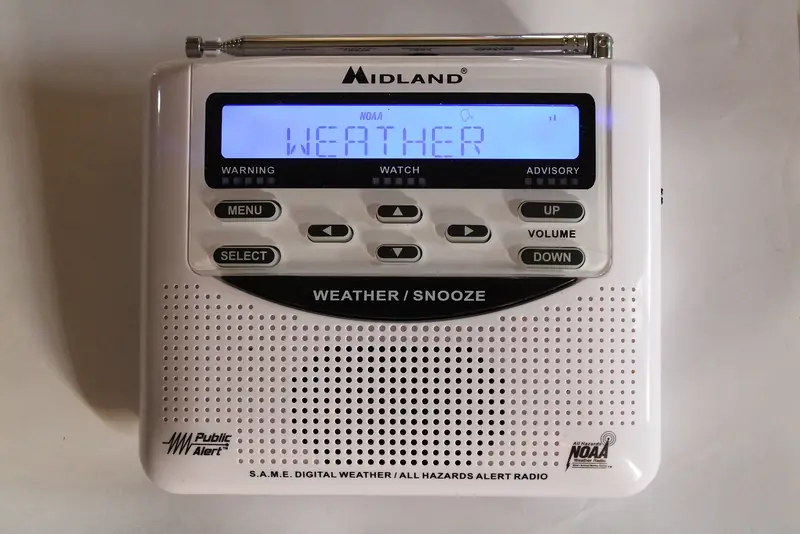
- A battery or hand-crank radio and a NOAA Weather Radio with a tone alert
- Flashlights, extra batteries and a first aid kit
- A whistle, dust masks, moist towelettes and garbage bags
- Medicine, phone chargers and a backup battery
- Cash and copies of important papers in a waterproof container
Ready.gov suggests checking the kit every year and replacing anything expired (Ready.gov, Build a Kit).
Food and water at home
A closed refrigerator keeps food cold for about 4 hours and a full freezer for about 48 hours. Throw out food that has been at 40 degrees or warmer (Ready.gov, Power Outages). Ready.gov suggests replacing water you've stored yourself every 6 months (Ready.gov, Water).
When phones and internet go down
Home phone service that runs over your internet connection won't work in a power outage without a battery or other backup, according to the FCC. A traditional landline may still work with a corded phone (FCC and FEMA, Emergency Communications Tips). VoIP can also fail when the internet is down (FCC, VoIP and 911 Service).
When networks are busy, the FCC suggests texting instead of calling, keeping calls short, waiting 10 seconds before redialing, and picking an out-of-area contact everyone checks in with (FCC, Tips for Communicating in an Emergency). A NOAA Weather Radio keeps warnings coming when nothing else works.
Quick answers
What should I stock up on in case the grid goes down?
Ready.gov's basic kit covers water, food, flashlights, a battery or hand-crank radio, first aid, medicine, chargers, cash and copies of documents. Plan for at least 1 gallon of water per person per day for several days.
Can I run a generator in my storm shelter?
No. Ready.gov says generators belong outdoors, at least 20 feet from windows, doors and attached garages, because of carbon monoxide.
Will cell phones work if the internet goes down?
Often they will, but networks get busy. The FCC suggests texting instead of calling, keeping calls short and waiting 10 seconds before redialing. Home phone service that runs over the internet needs backup power to work in an outage.
How long does food last without power?
Ready.gov says a closed refrigerator keeps food cold for about 4 hours and a full freezer for about 48 hours. Throw out food that has reached 40 degrees or more.
This is a general guide built from public sources, not engineering, medical or legal advice. Follow local officials during an emergency.
Sources: NWS Little Rock, January 2009 ice storm; KAIT, 2009 ice storm 15 years later; FEMA, Highlights of ICC 500-2023; FEMA P-320, third edition (copy hosted by the National Weather Service); Ready.gov, Build a Kit; Ready.gov, Water; Ready.gov, Power Outages; FCC and FEMA, Emergency Communications Tips; FCC, VoIP and 911 Service; FCC, Tips for Communicating in an Emergency.
Get a storm shelter quote
Only your name and phone are required. A local installer follows up with you.
How this works
- We pass your request to one local installer who covers your area, or to up to 3 if you tick the box.
- If they can take the job, they call or email you to ask about the site and give you a price.
- Sending a request is free, and you don't have to hire anyone.
Angi puts the national average for a tornado shelter at $7,643, and most homeowners pay between $2,892 and $13,281. Source: Angi, 2026 tornado shelter cost guide.
Last updated